Measurement and governance | Updated July 2026
The Specificity Thesis
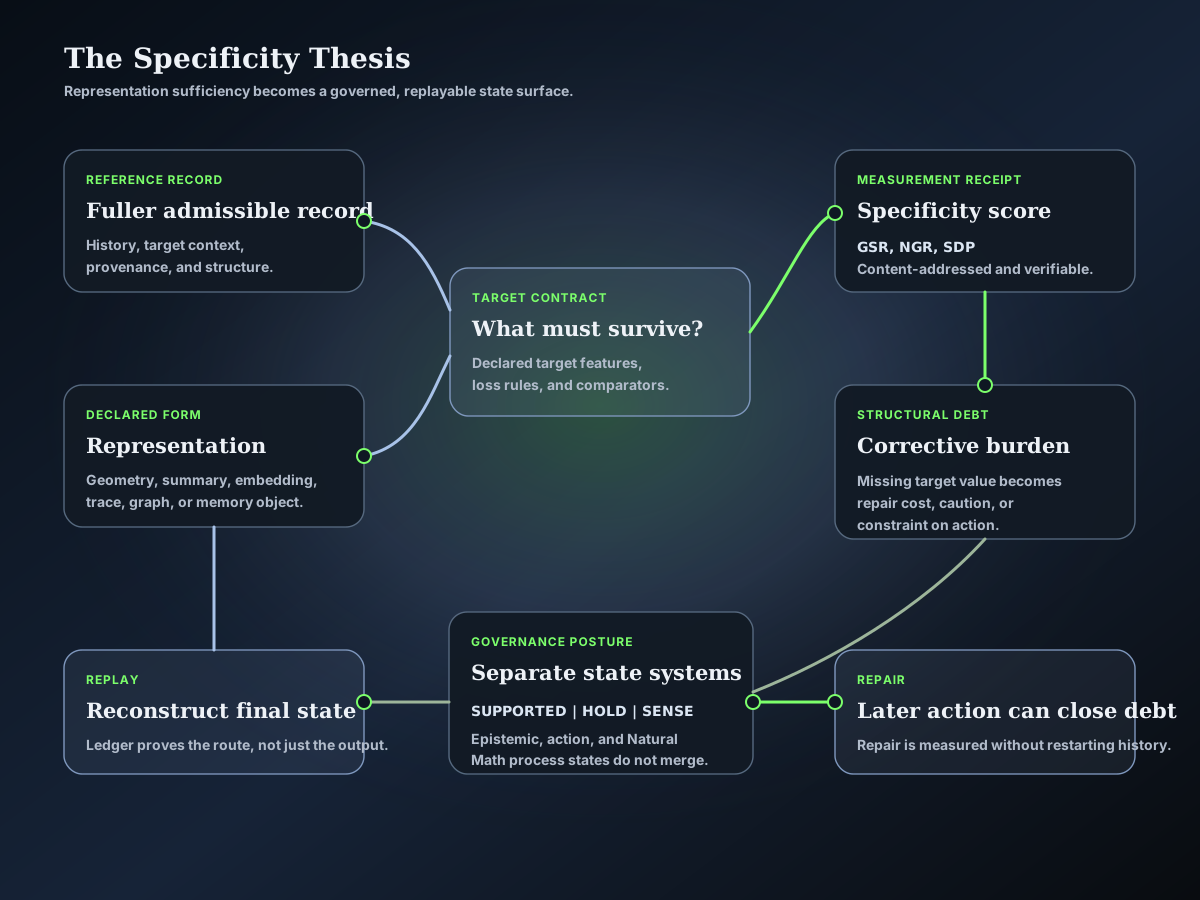
Specificity asks whether a declared representation preserves the target-relevant structure it is being asked to carry, and what governance burden follows when it does not.
Core definition
The Specificity Thesis states that representation quality should be evaluated against declared target requirements rather than against aesthetic compactness, apparent geometric elegance, or downstream performance in isolation.
A representation may be useful and still be insufficient. If target-relevant structure is missing, the missing structure should become explicit residue, measurable structural debt, and a governed action constraint.
Relationship to Ageometrics
Ageometrics measures what a declared geometry preserves and what residue remains outside it. Specificity generalizes that governance concern across representations used inside the platform: embeddings, summaries, traces, graphs, memory objects, replay states, and device evidence records.
In practical terms, Ageometrics supplies representation-sufficiency discipline. Specificity makes that discipline executable inside Cognitive Basin governance and replay.
Implementation surface
Specificity receipts
Receipts bind a target contract, observed feature recovery, comparator policy, GSR/NGR-style measurements, and content-addressed verification into a repeatable artifact.
Structural debt
Missing target-relevant value becomes an explicit debt assessment rather than an untracked narrative concern.
Governed posture
Debt can constrain action through declared policies. The result can extend, hold, retract, caution, constrain, or require repair depending on the state namespace and policy.
Replay and repair
A later action can repair a representation failure without erasing the earlier failure. Replay must reconstruct both the failure and the repaired final state.
State boundaries
The current implementation keeps the Cognitive Basin and Natural Math state systems separate.
- Cognitive Basin epistemic states:
SUPPORTED,UNRESOLVED,CONTRADICTED - Cognitive Basin action states:
EXTEND,HOLD,RETRACT - Natural Math local process states:
EXTEND,SENSE,RESTRICT
HOLD is not SENSE. RETRACT is not RESTRICT. The distinction is part of the public contract.
Current proof obligations
- The declared representation must actually affect the measured specificity outcome.
- A missing feature must become residue and debt, not a hidden exception.
- Governance posture must follow declared policy rather than narrative pressure.
- Replay must reconstruct final governed state and detect tampering.
- Repair must close debt without restarting the history.
Claim boundary
The Specificity Thesis is a measurement and governance program. It does not establish universal representation adequacy, artificial personhood, proven sentience, medical authority, or a universal decoder.