Technical metric page
Home / Ageometrics / Geometric Sufficiency Ratio
Geometric Sufficiency Ratio
GSR measures how much target-relevant predictive value survives a declared geometric compression under a controlled comparator protocol.
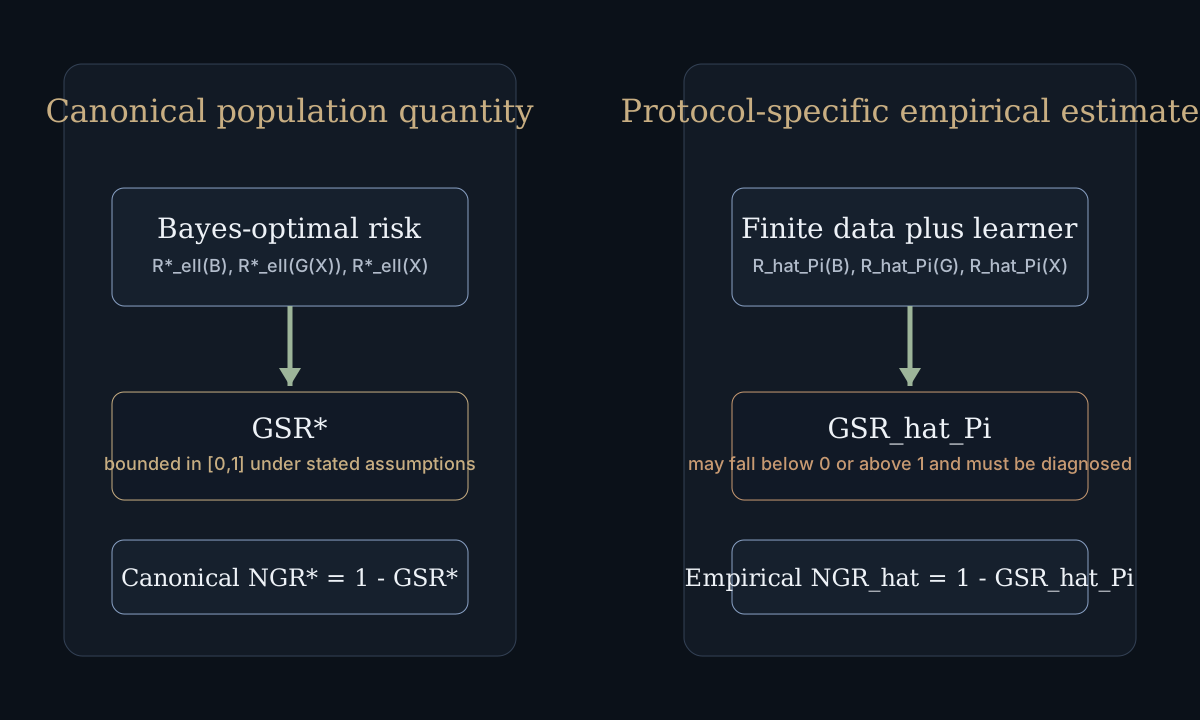
A GSR estimate without a comparator protocol is not an Ageometrics result.
1. Concise definition
GSR is a task-relative ratio comparing the risk reduction preserved by a declared geometric representation against the risk reduction available from a declared fuller reference record.
2. Why comparator discipline matters
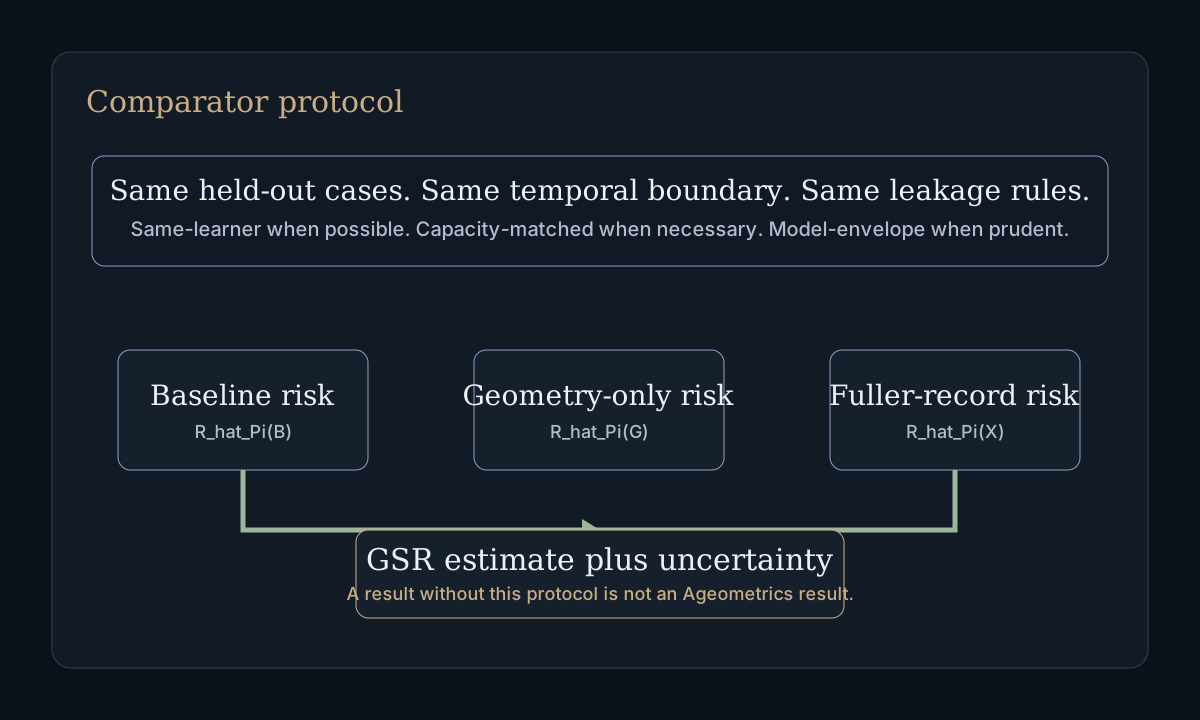
The central failure mode is easy to state and easy to miss: if the geometry-only path is evaluated with one learner family and the fuller record with a stronger one, the measured gap may reflect learner advantage rather than representational insufficiency.
3. Declared objects
X: declared fuller reference record available at prediction or decision timeG(X): specified geometric representation derived fromXB: declared baseline information or baseline predictorY: targetell: declared loss, with lower preferredPi: complete empirical comparison protocol
4. Canonical Bayes-risk definition
R*_ell(Z) = inf_f E[ell(Y, f(Z))]GSR*_{ell,Y}(G | X,B)
=
[R*_ell(B) - R*_ell(G(X))]
/
[R*_ell(B) - R*_ell(X)]R*_ell(B) > R*_ell(X)5. Boundedness assumptions
R*_ell(X) <= R*_ell(G(X)) <= R*_ell(B)When the geometry is derived from the fuller record, the fuller record can reproduce the geometry-only decision rule, and the geometry is at least as informative as the baseline, the canonical population quantity is bounded:
0 <= GSR* <= 1Boundedness is not automatic when those assumptions fail.
6. Empirical protocol-specific estimator
GSR_hat_Pi
=
[R_hat_Pi(B) - R_hat_Pi(G)]
/
[R_hat_Pi(B) - R_hat_Pi(X)]
The three empirical risks should be evaluated on the same held-out cases, under the same temporal-availability rules, with declared comparator controls and leakage safeguards.
7. Same-learner, approximately capacity-matched, and model-envelope views
- Same-learner GSR: the same declared predictive family, preprocessing policy, search budget, partitions, and stopping rule are applied when technically possible. This holds much of the observer and protocol fixed while remaining observer- and architecture-relative.
- Approximately capacity-matched GSR: when input forms require different model families, parameter count, training compute, data exposure, tuning effort, regularization, and stopping criteria are matched as closely as practicable and the remaining asymmetries are reported.
- Model-envelope GSR: several credible predictive families are reported to expose observer dependence. This is a robustness-oriented view, not an automatically conservative one.
8. Worked 0.75 / 0.80 / 0.95 example
Accuracy form:
(0.80 - 0.75) / (0.95 - 0.75) = 0.25Error-risk form:
(0.25 - 0.20) / (0.25 - 0.05) = 0.25Raw geometry-only performance can sound strong while still preserving only a small share of the recoverable improvement.
9. Empirical interval violations
Empirical estimates below 0 or above 1 can occur because of finite samples, regularization, optimization, model mismatch, or comparator imbalance. These values are diagnostic and should be preserved, not silently clipped.
10. Canonical and empirical NGR
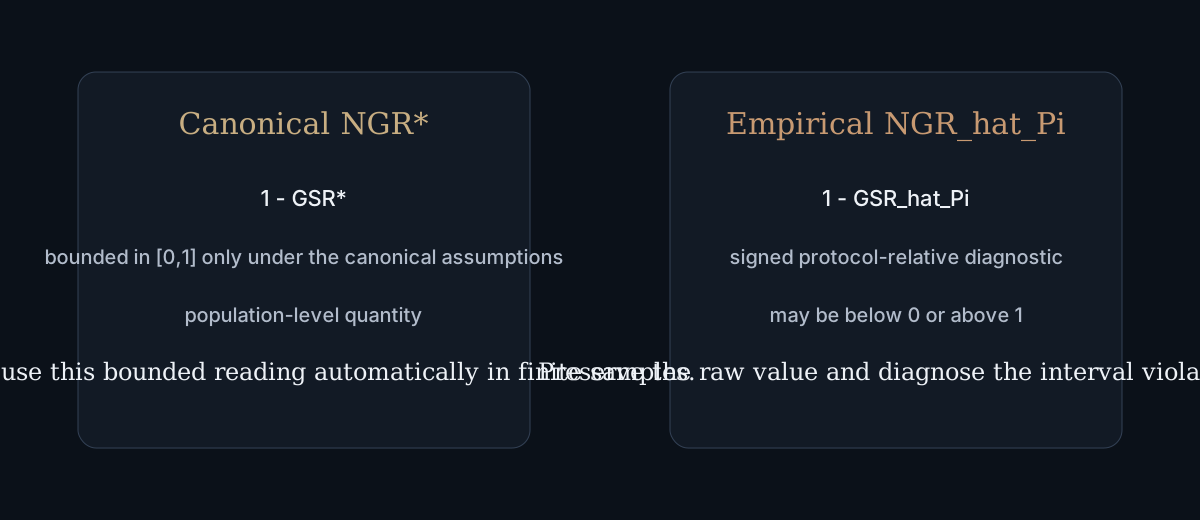
NGR* = 1 - GSR*NGR_hat_Pi = 1 - GSR_hat_PiNGR is not a metaphysical non-geometric substance. It is a target-, representation-, loss-, and protocol-relative performance gap.
11. Information-theoretic companion
GSR^I_Y(G | X) = I(G(X);Y) / I(X;Y)This companion connects Ageometrics to Information Bottleneck thinking. It is not the default empirical estimator because high-dimensional mutual information can be unstable to estimate.
12. Interventional GSR
Interventional GSR asks how much of intervention-response prediction survives geometric compression, rather than passive observation alone.
13. Temporal GSR
Temporal GSR asks how much target-relevant information remains when developmental or event history is compressed into final-state or trajectory geometry.
14. Representation-stability envelope
One geometry is rarely enough. The representation-stability envelope summarizes GSR across a family of admissible geometric representations of the same record. A wide envelope means the sufficiency claim depends too heavily on representation choice.
15. Encoding cost
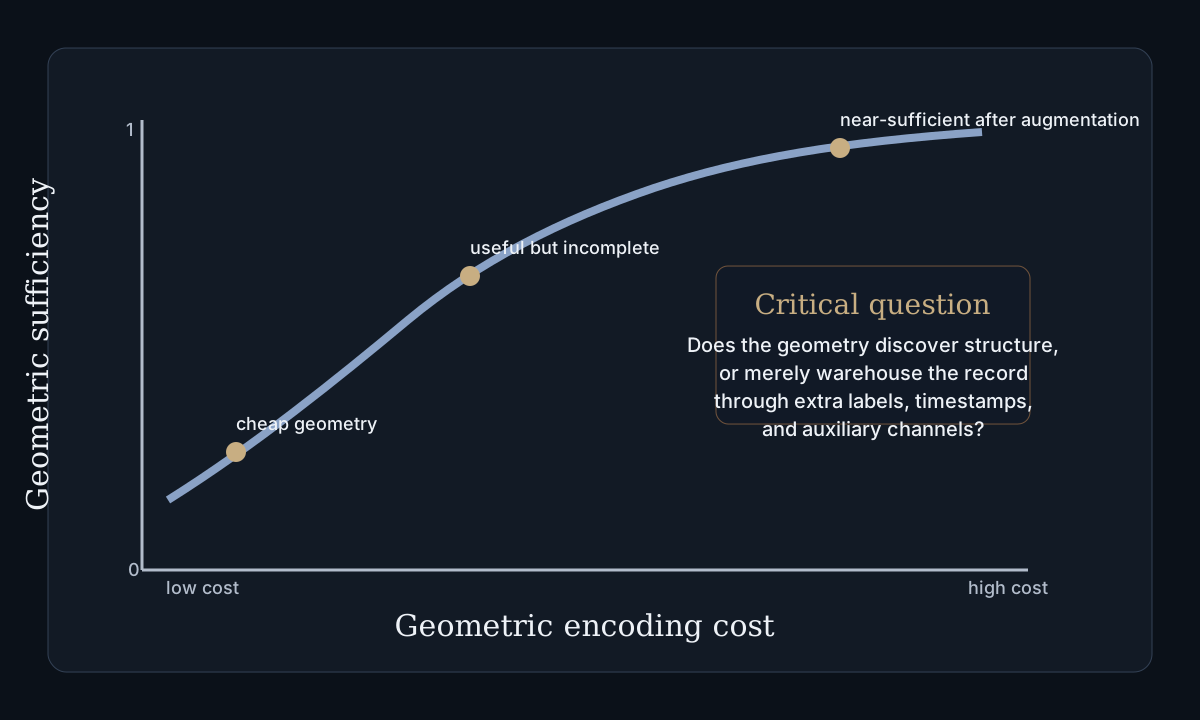
Encoding cost forces a harder question: did the geometry expose structure, or did it merely absorb timestamps, labels, provenance, and interventions until it became a renamed full record?
16. Minimal residue-restoring channel
A useful benchmark can ask what smallest auxiliary channel restores sufficiency above a declared threshold. That channel identifies what the geometry was missing.
17. Benchmark protocol
At minimum, an Ageometrics benchmark should declare the fuller reference record, the geometry, the baseline, the target, the loss, the temporal boundary, the learner controls, the uncertainty method, and the leakage-risk plan.
18. Statistical cautions
- Comparator unfairness
- Model-class confounding
- Target leakage and future information
- Geometry smuggling through labels or timestamps
- Small-denominator instability
19. Open questions
- Which proper losses are best by domain?
- How should uncertainty be propagated for ratio estimators?
- How should model-envelope results be aggregated?
- When are cross-domain comparisons meaningful?
20. Downloads and citation